

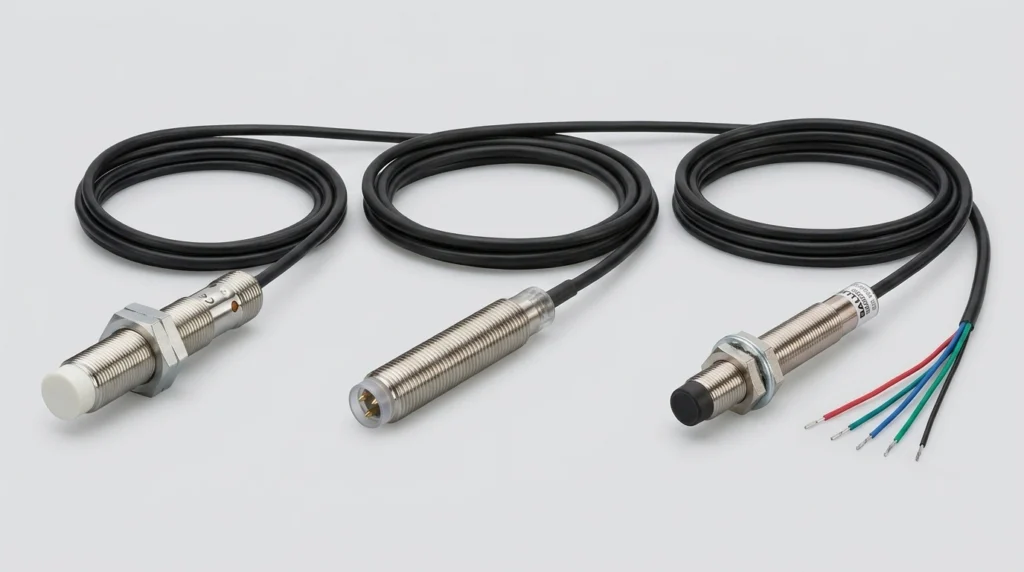
IFM Electronic Sensors: Product Guide for IFM204, BES013N, BES02F0 and IFM Sensor Cables
Master your setup with IFM sensors and cables. Decode the IFM204, clarify Balluff cross-references, check wiring steps, and configure IO-Link masters.
The 1769-L36ERM is Rockwell Automation’s CompactLogix 5370 L3 controller designed for mid-to-large machine-level automation – positioned above the packaged L24ER-series and below the legacy L45ERM, it fills the gap where I/O density and integrated motion control both matter. With 3 MB of user memory, 30 expansion module slots, dual EtherNet/IP ports, and support for up to 16 CIP motion axes, it handles what most mid-tier applications demand without adding a separate motion controller to the cabinet.
Engineers moving up from the 1769 L24ER QB1B – limited to 750 KB of memory and just four expansion modules – will find the step to the L36ERM substantial. Not just in raw capacity, but in what the architecture can actually do.
| Specification | 1769-L36ERM |
| Controller Family | CompactLogix 5370 L3 |
| User Memory | 3 MB |
| Max 1769 I/O Modules | 30 (up to 3 banks) |
| CIP Motion Axes | Up to 16 |
| EtherNet/IP Nodes | Up to 48 |
| TCP Connections | Up to 120 |
| Built-in Ports | 2 × EtherNet/IP, 1 × USB |
| Programming Software | Studio 5000 Logix Designer v21 or later |
| SD Card | Ships with 1 GB; supports up to 2 GB |
| Mounting | DIN rail or panel |
| Replaces | 1769-L35E |
The 3 MB memory is a real jump from the 2 MB on the L33ERM – particularly relevant in applications with dense function block logic or large tag databases. Memory alone rarely decides the purchase, though. The 16-axis CIP motion ceiling and 48 EtherNet/IP nodes are usually what put this catalog number on the shortlist.
Each segment of “1769-L36ERM” carries specific meaning:
That final M is the critical differentiator. The 1769-L36ER (no M) lacks integrated motion entirely. For any application involving servo coordination – conveyors, packaging, robotics – the M variant is non-negotiable.
The 1769-L36ERM requires Studio 5000 Logix Designer version 21 or later, aligned with firmware revision 21.xxx and above. Existing RSLogix 5000 projects can be converted, but teams on pre-v21 software with legacy hardware need to account for that migration before specifying this controller on a retrofit.
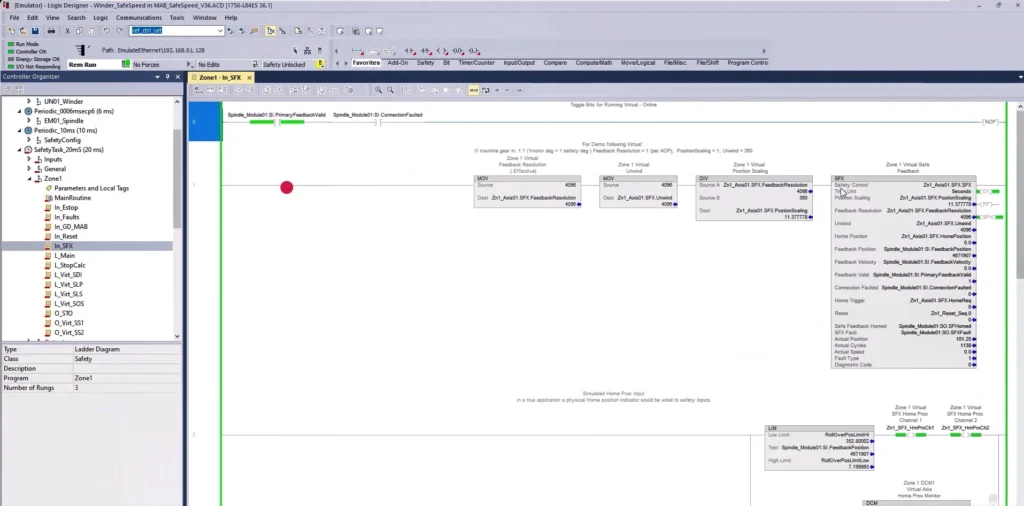
Unlike the packaged 1769-L24ER-QBFC1B – which includes an embedded 24V DC power supply and onboard I/O – the L36ERM is a modular controller. A dedicated 1769 power supply module mounts directly to the left of the controller on the CompactBus backplane. This is not optional; the controller will not operate without it.
Rockwell recommends a regulated 24V DC external supply meeting these criteria:
The 1769 power supply uses a three-terminal connector:
Grounding is where most installation problems originate. The PE terminal must connect to a low-impedance earth ground through a dedicated ground bus bar bonded to the panel chassis. Daisy-chaining grounds between modules adds impedance that shows up as analog I/O noise – often after commissioning, which makes it harder to diagnose. Rockwell’s Industrial Automation Wiring and Grounding Guidelines (publication 1770-4.1) is the reference document here.
The dual Ethernet ports share a single IP address and operate as an embedded switch. Three network topologies are supported natively:
DLR is the preferred topology for conveyor lines or ring-bus layouts where physical cable runs make breaks more likely. The USB port on the front panel is for programming and firmware updates only – not for permanent connection.
The L36ERM supports 30 expansion modules across three banks, connected via 1769-CRR1 or 1769-CRR3 expansion cables. Each bank needs its own 1769 power supply, and up to eight modules can sit on each side of that supply. Planning the physical layout before purchasing avoids rework during panel assembly.
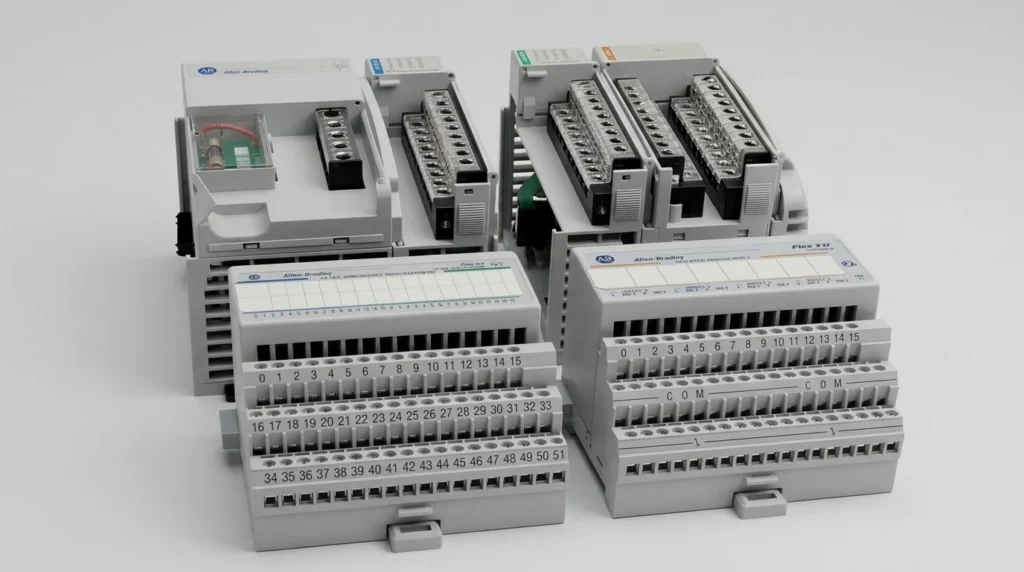
Commonly used modules in L36ERM systems:
For motion axes, the L36ERM uses CIP Motion over EtherNet/IP – servo drives connect through the network, not the CompactBus. That keeps the backplane free for I/O and simplifies cabinet wiring. Kinematics support covers delta robot and gantry configurations without a dedicated motion controller.
One important distinction: the 1769-L24ER-QBFC1B is sometimes compared to the L36ERM because both carry the 1769 prefix, but they’re different classes entirely. The 1769-L24ER-QBFC1B is a packaged L2 controller with embedded I/O and a hard limit of four expansion modules – appropriate for standalone machines, not for multi-zone or motion-intensive systems.
This comparison covers the controllers buyers most often evaluate side by side.
| Feature | 1769 L24ER QB1B / 1769-L24ER-QBFC1B | 1769-L36ERM | 1769-L45* |
| Controller Class | L2 (packaged) | L3 (modular) | L3 (modular) |
| User Memory | 750 KB | 3 MB | 4 MB |
| Max 1769 I/O Modules | 4 | 30 | 30 |
| CIP Motion Axes | None (L24ER) | 16 | 16 |
| EtherNet/IP Nodes | 8 | 48 | 48 |
| Embedded I/O | Yes | No | No |
| Next-Gen Equivalent | – | 5069-L320ERM | 5069-L306ERM |
*The 1769-L45 belongs to the older CompactLogix 1768 series, compatible only with RSLogix 5000 v20 or earlier. It’s included here for reference – for new designs, the 5069 Compact 5000 series is the current forward path.
The 1769-L36ERM replaced the 1769-L35E, which had a single EtherNet/IP port, an RS-232 serial port, CompactFlash storage, and no motion capability. Facilities still running L35E hardware have a documented upgrade path to the L36ERM with significantly expanded communication and motion features.
For new machine designs with a longer lifecycle in mind, the 5069-L320ERM (Compact 5000 series) offers higher memory, faster scan times, and broader safety integration – worth evaluating in parallel.
The 30-module capacity, 16-axis motion, and 48-node Ethernet connectivity position this controller across several demanding application types:
Conveyor and material handling systems – High I/O counts from zone sensors, variable-speed drives, and photoelectric arrays fit comfortably within the L36ERM’s expansion capacity. DLR topology suits the long linear cable runs that conveyors naturally produce, and direct EtherNet/IP integration with PowerFlex drives eliminates the need for separate drive networks.
Batch processing and mixing – Temperature, pressure, and flow control via analog modules (1769-IF4, 1769-OF2) combined with sequenced digital outputs for valves and pumps. The 3 MB memory handles complex SFC programs, and open socket capability supports native Modbus TCP for legacy process instruments.
Packaging lines – Multi-axis servo coordination for pick-and-place, form-fill-seal, and labeling stays within the 16-axis CIP Motion limit. Kinematics support handles delta robot applications. Keeping motion logic inside the same Studio 5000 project – rather than a separate motion controller – reduces integration complexity and commissioning time.
For engineers who’ve confirmed the 1769-L36ERM is the right fit, check current stock and pricing on Zancot – inventory covers both new and surplus units, with competitive pricing and sourcing support. Zancot also stocks compatible 1769 CompactLogix power supplies and I/O expansion modules to simplify full-panel procurement.
Does the 1769-L36ERM include an embedded power supply?
No. It requires a dedicated 1769 power supply module (1769-PA2 or 1769-PA4) mounted to the left on the CompactBus backplane.
How many I/O modules can connect to the 1769-L36ERM?
Up to 30 local 1769 Compact I/O modules across three expansion banks. Each bank uses an expansion cable and its own power supply.
What programming software does the 1769-L36ERM require?
Studio 5000 Logix Designer version 21 or later. RSLogix 5000 projects from earlier versions can be converted but should be validated before deployment.
What controller did the 1769-L36ERM replace?
It replaced the 1769-L35E, adding dual Ethernet, USB programming port, SD card storage, and integrated CIP Motion – none of which were available on the L35E.
Is the 1769-L24ER-QBFC1B a smaller version of the L36ERM?
No. The 1769-L24ER-QBFC1B is an L2 packaged controller with embedded I/O and a four-module expansion limit. It belongs to a different product class and is not interchangeable with the L36ERM.
Technical specifications sourced from Rockwell Automation CompactLogix 5370 Selection Guide (1769-SG001) and CompactLogix Controllers Specifications Technical Data (1769-TD005).
Master your setup with IFM sensors and cables. Decode the IFM204, clarify Balluff cross-references, check wiring steps, and configure IO-Link masters.
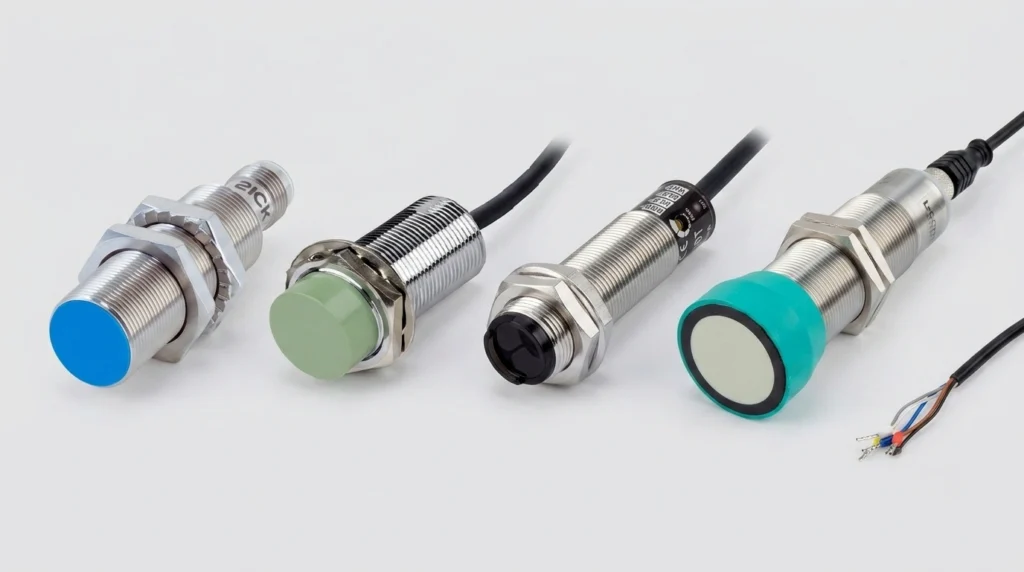
A practical industrial sensors guide covering proximity, photoelectric, ultrasonic, pressure and flow types, wiring, IP ratings, and top brands.
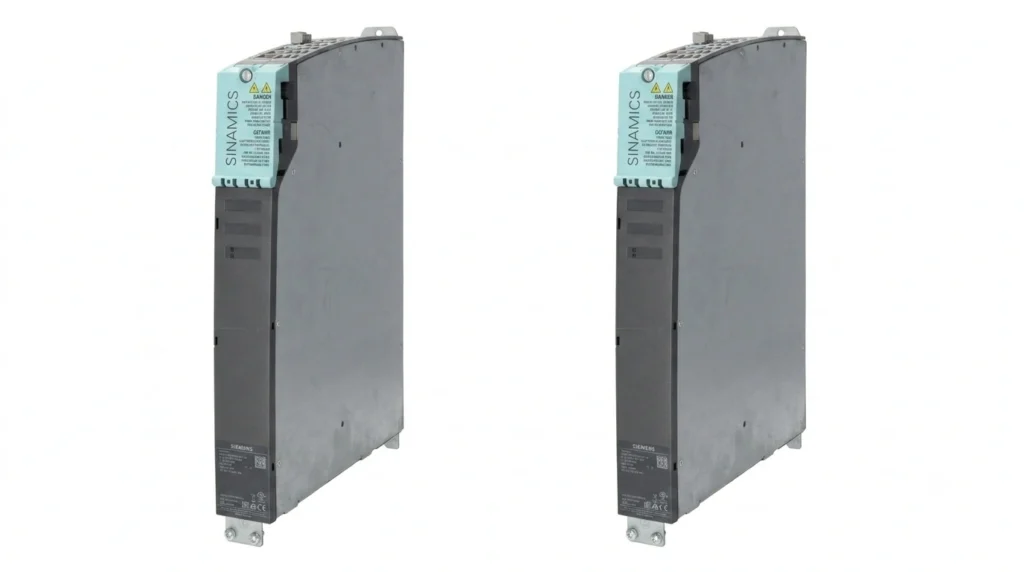
Navigate your Siemens VFD replacements. Decode SINAMICS S120 & G120 modules, configure software, and troubleshoot legacy MICROMASTER 440 fault codes.